Is it safe to drive in Cape Town?
Yes, for most visitors driving in Cape Town is safe and it is the easiest way to see the city. Roads are well built, signage is in English, and the main tourist routes are busy and patrolled. The real risks are opportunistic: smash-and-grab at a handful of known intersections, theft from parked cars, and unlit roads at night. Keep valuables out of sight, keep doors locked, stick to main routes after dark, and you remove most of the risk.
Should I rent a car in Cape Town?
If you plan to leave the City Bowl at all, yes. Public transport does not reach Chapman's Peak, Cape Point, the winelands or most beaches, and ride-hailing to those areas gets expensive fast. Rent the smallest car that fits your luggage, take the tyre and windscreen waiver, and check the spare wheel before you drive off.
Is the N2 to the airport safe?
The N2 between Cape Town International and the city is safe in daylight and in normal traffic. The stretch past Borcherds Quarry and Nyanga has had incidents when traffic is stopped or at night. Drive it in daylight where you can, keep bags in the boot and not on the back seat, leave a car length in front of you so you can always pull out, and keep windows up.
What is smash and grab?
Smash and grab is when someone breaks a side window of a stationary or slow-moving car at an intersection and takes whatever is visible, usually a phone or bag, then runs. It takes a few seconds. It is prevented almost entirely by keeping the passenger seat and footwells empty, putting bags in the boot before you set off, and not holding your phone in view at a red light.
Can tourists drive in South Africa with a foreign license?
Yes. You can drive on a valid foreign licence for up to 12 months if it is in English and carries your photograph and signature. If it is not in English, carry an International Driving Permit alongside it. Keep the licence on you, not in the hotel safe, because traffic officers can ask for it at a roadblock.
What side of the road do you drive on in South Africa?
South Africa drives on the left, with the steering wheel on the right, the same as the UK, Australia and India. Overtake on the right. At a four-way stop the first car to arrive goes first, and at a traffic circle you give way to traffic already in the circle, coming from your right.
Do I need an international driving permit in South Africa?
No, not if your licence is printed in English and carries your photograph and signature. That covers UK, Irish, US, Canadian, Australian, New Zealand and most EU photocard licences. If your licence is in any other language you must carry an International Driving Permit with it. You may drive on a valid foreign licence for up to 12 months from entry.
What is the speed limit in Cape Town?
60 km/h in built-up urban areas, 100 km/h on rural roads outside towns, and 120 km/h on freeways such as the N1, N2 and R300. Lower posted limits override these, and the M3 through Wynberg and Newlands is average-speed enforced at 80 km/h. Speed is measured in kilometres per hour everywhere in South Africa.
How much is the Chapman's Peak toll?
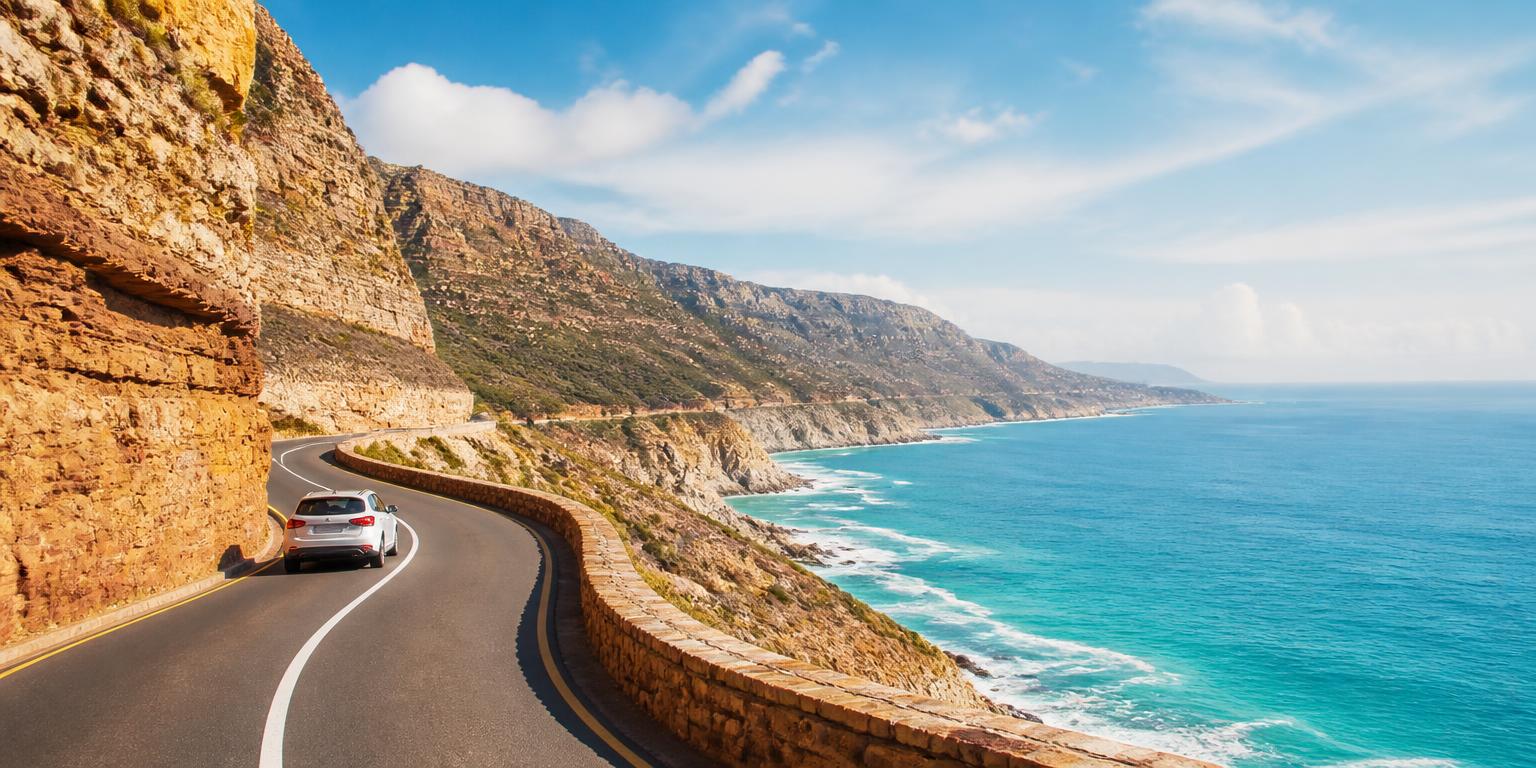
Roughly R60-R70 per direction for a standard car. Tariffs are reviewed annually on 1 July, and you pay by card at the plaza on the Hout Bay side. Check the operator's site for the current published tariff and the live open or closed status before you set out. chapmanspeakdrive.co.za — current tariff and open/closed status
How much should I tip a car guard?
R5 to R10 for a short stop such as a shop or a restaurant, and R10 to R20 if the car has been there a few hours or it is after dark. Pay when you leave, not when you arrive, and pay in coins. Car guards are informal, not municipal employees, and this is their whole income.
Is it safe to drive from Cape Town airport at night?
It is generally fine if you stay on the N2 with the doors locked, the windows up and all luggage in the boot, and drive straight through without stopping. The 22 km run to the City Bowl takes about 20 to 25 minutes at night. Do not take the Borcherds Quarry or Nyanga offramps, do not stop on the shoulder, and treat a dead traffic light during load-shedding as a four-way stop.